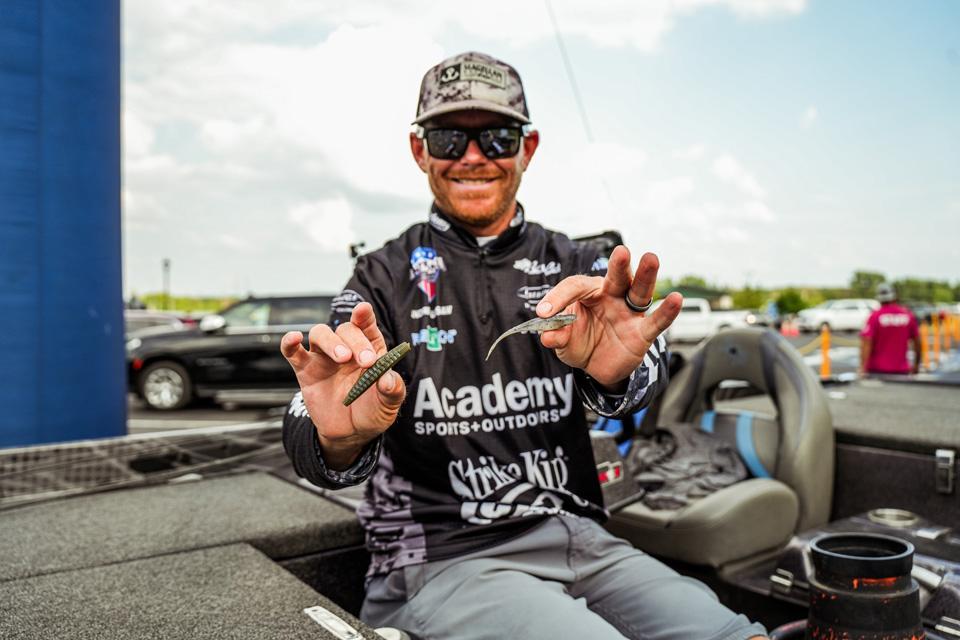
Story by Andrew Upshaw | Photos by Tanner & Travis Lyons
When I made the decision in 2024 to fish the NPFL for my first season in 2025, I knew it was going to be a big change.
For the last seven years, I had grown very accustomed to using forward-facing sonar—specifically Lowrance ActiveTarget 2. There’s no denying it: forward-facing sonar is one of the most eye-opening and successful technologies our sport has ever seen. It started to disprove a lot of things we thought we knew about bass—how they move, where they go, and when they’re actually there. It completely changed the way many of us fish, myself included.
Coming into the season, I honestly didn’t know how the transition would go. In the Bassmaster Opens over the last few years, I didn’t lean heavily on forward-facing sonar. I mostly just went fishing—frogging, flipping, sight fishing—doing different things to separate myself from the field and find my own fish. That approach always felt natural to me.
But what I didn’t realize until 2025 was just how often I relied on forward-facing sonar, even when I wasn’t actively “scoping” fish. Whether it was finding a random stump in the middle of nowhere, locating a brush pile, lining up a deep-water cast, or just confirming what I was seeing—ActiveTarget had quietly become a constant part of my process. You don’t really notice it until it’s gone.
In a way, this season felt like coming full circle.
I started my professional career back in 2012 on the FLW Tour, long before forward-facing sonar was ever part of the conversation—or at least before I knew anything about it. Back then, everything revolved around patterns, seasonal movements, and instincts. You learned how fish positioned, how they transitioned, and why they were where they were.
The first few tournaments of the NPFL season were a process of rediscovering that version of myself.
Day 1 of my very first NPFL event, I caught 28 pounds throwing a Strike King Thunder Cricket. And I’ll tell you right now—that was one of the most fun bites I’ve had in a long time. It reminded me why I fell in love with fishing in the first place.
After that, though, I narrowly missed check after check until we hit the St. Lawrence River. That’s where things finally clicked. The way I like to put it—I pulled my head out of my butt and started doing what I know how to do. Sight fishing. Fishing offshore. Fishing deep. The same approach carried over to Logan Martin, and from there the season started to make more sense.
So, what does 2026 hold?
It holds a lot of opportunity.
I’ve become comfortable again with simply going fishing—without depending on forward-facing sonar. I’ve been digging back into the old toolbox, pulling out techniques and approaches that made me successful during my FLW days. In a strange way, it feels like retraining my brain for the third time.
First, it was all about patterns and fish behavior.
Then came forward-facing sonar, where we could literally see fish and, in some situations, chase them down in open water.
Now, I’m back to patterns—but with a deeper understanding of how fish roam, transition, and react because of everything sonar has taught us.
The big question for 2026 is this: How do you blend that knowledge with a no-scope approach and still separate yourself from the field?
That’s what I’m focused on—finding that balance, targeting roaming fish without electronics like ActiveTarget, and continuing to evolve as an angler. The goal is simple: catch more bass, catch bigger bass, and keep pushing myself to be better than I was the year before.
That’s the challenge I’m excited about for 2026.
Andrew Upshaw – Angler Profile