Story by Hunter Sales | Photos by Tanner & Travis Lyons
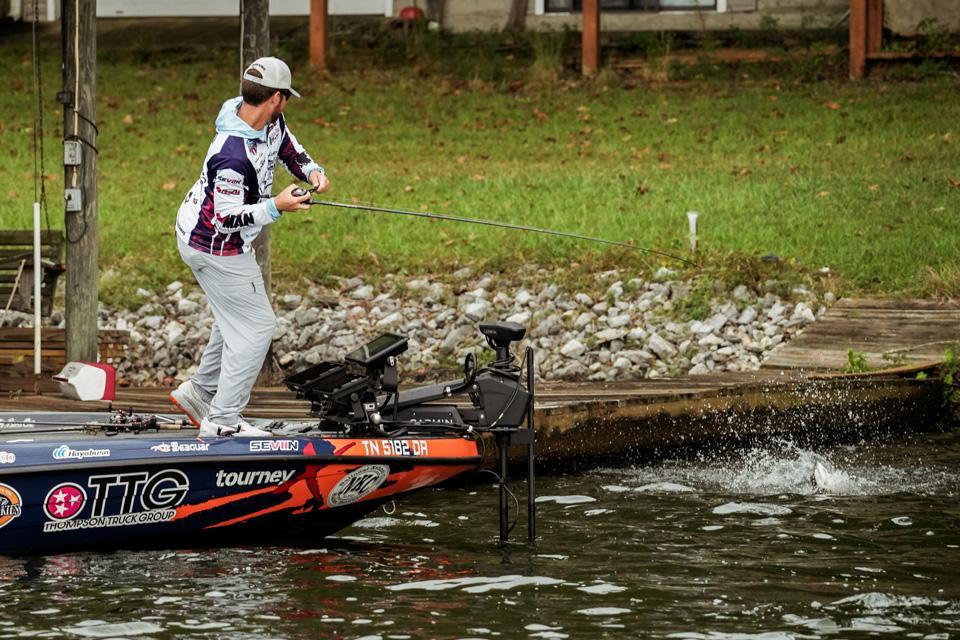
If this article comes off as a bit of a rant, it’s probably because it is. Disclaimer: I’m not perfect here either. However, as someone who quite literally gets paid to teach people how to put more fish in the boat, this is a pet peeve of mine. Social media highlights and viral clips have convinced bass anglers around the world that “slackline” herculean hooksets are needed. In 90% of cases, this simply isn’t true. Let’s talk about a better approach and when you can hit them hard.
To start, my problem with swinging too hard on hooksets is entirely based upon what it does to your landing percentage. Twenty years ago, these big hooksets were actually needed. Monofilament line had a ton of stretch, and it seemed that the average rod was shorter and softer than they are today. Both fluorocarbon and braid are extremely low stretch in relation to the lines of yesterday. Additionally, the technology surrounding hooks has also improved dramatically. Today’s hooks are both thinner and stronger than previous generations, resulting in better penetration with less effort. I use Hayabusa hooks and I’ve always been extremely impressed with the penetration. Setting the hook too hard causes two problems: It cuts an unnecessarily large hole in the fish’s mouth and creates slack in your line.
Two different experiences really drove this point home to me. For one, I have hooked a ton of fish without setting the hook. In practice, I try to shake off most of my bites but still end up catching 20% or so without setting the hook at all. Modern hooks are really sharp. Second, I have spent a lot of time punching matted grass. It’s one of my favorite things to do. You only lose fish for one reason, and that is getting slack in your line. Sometimes the fish can create this slack by getting you wrapped up in the mat, but oftentimes you’ll lose fish due to the slack that you inadvertently create.
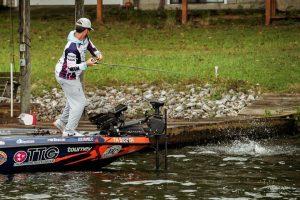
Talk to any of the grass flipping connoisseurs, and they’ll tell you the best hookset is one that you reel until the line gets tight, lean hard into the fish and start turning the reel handle. Whether in grass with braid or flipping any other shallow cover, when you drop the rod tip and “slackline” the hookset, you end up in a situation where you’re having to use the reel to keep pressure on the fish while you get your rod back into position. The worst combo? A fish that now has a hole bigger than the barb cut in his mouth, coming towards the boat, and a rod tip that is out of position.
One of the only times that you can get away with hitting them hard is in very deep water. If there is a lot of distance between you and the bait, fluorocarbon line still has enough stretch to compensate for the hookset. Of course, there’s no disadvantage to reeling until the line is tight and leaning hard but hitting them hard can be fun. Some of the deep-water techniques where I will give you the green light are when using a Carolina-rig, big worm, heavy-wire football heads, or a free-rig.
I enjoy setting the hook hard as much as the next guy, but I’ve certainly seen a lot of fish get lost due to swinging too hard. This does seem to be more of a problem with our young anglers who understand that big hooksets get more views on social media! Next time you’re on a good bite, get your line tight and just lean hard into them. You will land more fish. If you need to set the hook as hard as you can, I can help point you in the direction of some better hooks.
Hunter Sales – Angler Profile