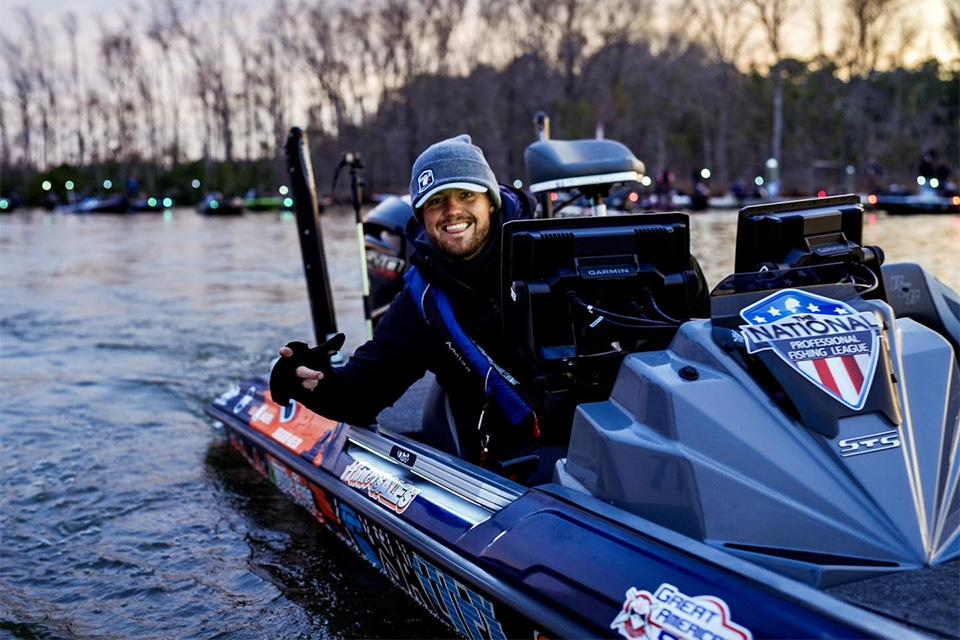
Story by Hunter Sales | Photos by Tanner & Travis Lyons
Cold fronts before the spawn have long been regarded as one of the toughest fishing conditions you can face as a bass angler. The Carson-Newman University fishing team just got back from Lake Okeechobee and the cold surge that has swept the country certainly prevented this event from being a full-blown shootout. Still, we were able to put three boats inside of the top 10 in that event. During a cold front, although the fishing slows, there are still bass to be caught. The key is finding stable water, keeping confidence, and maximizing opportunities.
Bass prefer stability in almost every aspect of their environment. Drastic, rapid changes in water level, water temperature, or water clarity can create situations that are not favorable for feeding. Gentle warming trends are best for springtime activity and likewise, rapid cooling trends are the worst. Finding water that is more resistant to these rapid changes is key to catching fish. In general, deeper water is more stable than shallow water as it takes longer to change temperature. When the weatherman is predicting a cold front, finding a population of fish in deep water can salvage your event. In East Tennessee this can be channel swing banks or bluffs. In Florida, canals seem to fill this role.
Equally important to capturing bass in suboptimal conditions is an angler’s confidence. Confidence allows you to slow down in an area where bass are living, and this is critical to putting five fish in the boat by weigh-in. When you condense the task at hand, getting five bites in an eight-hour window is not a particularly lofty goal. However, with fish that are not in a positive feeding mood, you can’t afford to fish too fast.
The best advice that I could give an angler during tough conditions is to slow way down. It seems like most of the time, the afternoon sun improves the bite window, and you absolutely have to be around a population of fish when they decide to feed. Staying in one area and combing through every target will ensure you don’t miss this feeding window by running around. You really need to keep the confidence that there are fish in your area and that they will bite at some point in the day.
During cold-front conditions, you likely won’t get too many bites. If you’re only getting five to seven bites per day, you must make sure that each opportunity results in a fish in the boat. We’ve all been there – it’s been hours since your last bite and you’re caught off guard and butcher a hookset, resulting in a missed fish. These small instances are the difference between the anglers who are great “grinders” and those who tend to fall behind when fishing gets tough. Being able to stay focused on each cast, flip, and feeling on the end of your line is difficult. In my career, I’ve seen the fifth keeper bite at the buzzer way too many times, and you must put that fish in the boat. If I find myself drifting in these situations, I reset by sitting down to retie or moving across the pocket.
The best anglers always find a way to make it work in tough conditions and its usually not by doing anything different than those around them. Instead, they focus, maximize opportunities, fish with confidence, and look for patterns that will hold up through the changes. In my baseball days, we’d refer to these anglers as being “mentally tough.” I think there’s a lot to be said about successful fishermen and mental toughness.
Hunter Sales – Angler Profile