Story by Ken Duke
These days, you can’t watch a sporting event or competition of any kind without hearing terms like “world record” or “Olympic record,” or “track record,” or some such thing, but it hasn’t always been like that, especially in bass fishing. Record keeping in the bass world got a bit of a late start, causing many (including me) to wonder what we may have missed in those early days.
I should start this piece by noting that true “sport fishing”—where the goal is to catch a fish deemed worthy of pursuit by “sporting means”—is relatively new as human endeavors go. Before the 19th century, fishing was purely a subsistence activity. People generally did not go fishing for the pleasure of it. They may have enjoyed it, but the goal was clear. They were out to get food.
And the culinary aspect of fish was a big part of determining which species would be considered “sport fish” and which were merely trash. If the public liked the taste of a fish species, it was classified as a “game” or “sport” fish early on. If not, it was a “rough” fish, unworthy of the table or of pursuit by gentlemen. (Few women were anglers, and those who were generally did not make it public.)
The largemouth bass had a bad reputation in the early days of sportfishing. In the mid 1800s, it was generally regarded as a low-class fish, living in dank, fetid waters, and tasting “muddy.” If you were a sporting angler, you pursued trout. That opinion persisted well into the 20th century in some areas.
The attitude among anglers that you always eat what you catch persisted until about 60 years ago. Catch and release was essentially unheard of before that, and it started in the freshwater trout world, not among bass anglers. We didn’t get on board with the concept of releasing fish alive so they could be caught again until the 1970s.
Of course, big fish have always impressed and always been noteworthy, but no one took up the burden of tracking and comparing such catches until the 1910s. That’s when Field & Stream magazine started an annual big fish contest.
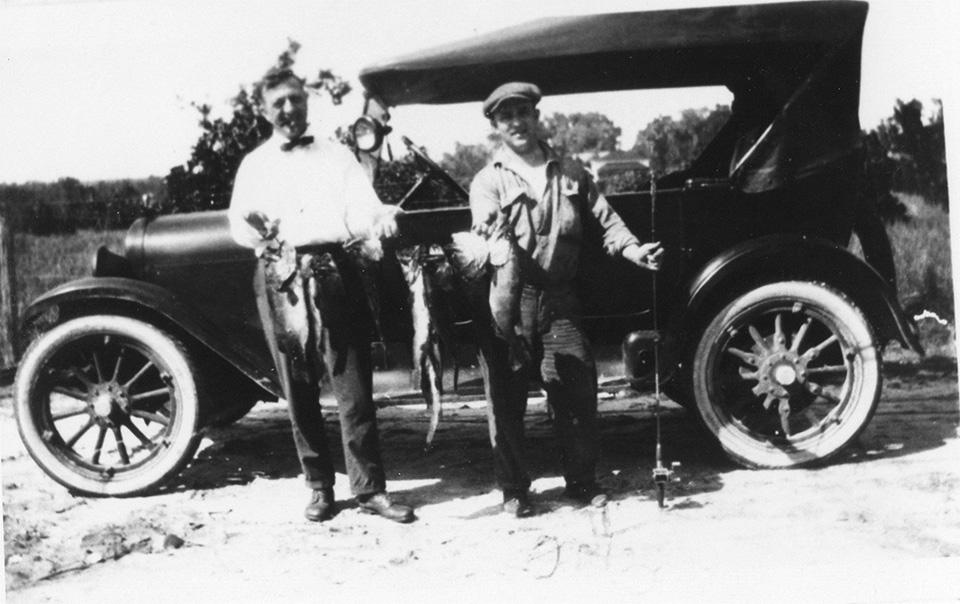
The Field & Stream contest ran from 1911 to 1977, and along about the 1920s, they began to realize they had accumulated quite a bit of data on big fish. Scanning their own lists of winners, they began to list “world records,” and they crowned Fritz Friebel of Tampa, Florida, as the man to beat in the largemouth bass category.
Friebel was an avid and talented angler — a traveling hardware salesman who carried his fishing tackle and some old clothes with him on the road so as not to miss any good opportunities. He didn’t own a boat but would wade up to his armpits in search of bass.
Friebel’s record catch is pretty well documented, but there are some questions. He reportedly caught the fish on Saturday, May 19, 1923, but years later he said it actually happened on the next day. “It was a Sunday morning when I should have been in church,” he admitted, “and I had to call a grocer to open his store to get the fish weighed.” Other reports maintain it was weighed on a postal scale. Either way, the scale was certified, and the fish measured 31 inches long and had a girth of 27 inches. When the scale settled on 20 pounds, 2 ounces, someone witnessing the weigh-in apparently accused Friebel of adding weight to the fish using lead sinkers.
That’s when Friebel pulled out his pocketknife, slit the fish’s belly open and suggested that someone reach inside to find out. There were no challengers after that.
When Field & Stream reported the catch in the September 1924 issue, declaring Friebel the winner of their 1923 contest, they laid it on thick:
Also in the Southern Large-mouth Black Bass Division, the world’s record for large-mouth black bass was smashed into flinders. Take off your hats, fishermen all, to … Mr. Fritz Friebel, world’s record-holder, large-mouth black bass. Mr. Friebel smashes the previous world’s record by 22 per cent, his amazing black bass weighing 20 pounds 2 ounces, against a former record weight for this class of fish of 16 1/2 pounds.
That 16 1/2-pound mark represents the next heaviest largemouth entered in the Field & Stream contest to that point. Larger fish—much larger fish—were occasionally reported, including a 23-2 in 1884 and a 24 pounder in the mid 1800s.
A second question surrounding Friebel’s catch was more critical than the date. Where did he catch the monster?
Initially, Friebel and the friends he was fishing with reported that the catch came from Moody Lake, just north of San Antonio, Florida, in Pasco County. You can see it from what’s now I-75. In fact, it came from nearby and aptly named Big Fish Lake, now (and then) located on private property.
What is not the subject of controversy is the lure Friebel used. It was a Creek Chub No. 700 Straight Pikie Minnow. The company was so proud of the catch that it featured Friebel in its 1928 catalog, noting “The Black Bass Record has been Broken — Not Cracked or Bent, but Crushed, Torn Apart and Split Wide Open…. Please leap to your feet and throw your hats into the air. Rah, Rah! To Mr. Friebel and his black bass.”
Friebel’s bass may be the largest ever caught in Florida, but it’s not the state record because a state biologist did not document the catch. No one thought about records in those days … including the state. The only reason a lot of these catches were ever weighed at all was because of the Field & Stream contest and the chance to win $50 or $75 worth of merchandise.
Ultimately, the first recognized world record bass met the same fate as almost every other bass caught in that era. After being displayed in a block of ice in a downtown Tampa shop window, it was cooked and eaten.